Modernising a legacy document platform without ever interrupting production.
Statements, renewal notices, contracts, invoices: a customer communication platform never stops. We migrate these platforms from the measurement of the estate through to the actual shutdown of the source platform, with proof of equivalence at every cutover.
CCM platforms produce documents at scale, critical to customer relations, compliance and operations. Evolving them involves complex repositories, numerous business rules and high demands for continuity, traceability and quality.
Purplsoft combines expertise in legacy environments, industrialisation technologies and transformation steering to modernise document platforms.
01
// 01 · what we do
A migration does not start with conversion, but with understanding the estate
Over the years, a CCM repository accumulates templates, variants, business rules and dependencies that are rarely documented in full. Migrating without understanding this estate means moving a complexity you do not control. A platform in production for fifteen or twenty years carries anything from a few hundred to several thousand document templates. Scale changes the size of the programme, never its method.
Our approach: measure, rationalise, rebuild and cut over step by step, combining business expertise, tool-assisted analysis and continuous validation.
M1 Measure the estate
A real inventory of templates, volumes produced over a rolling twelve months, dead templates, variants of the same document, business logic buried in the layouts. The study becomes a measurement, and the scope a figure.
M2 Rationalise and converge
Merge redundant templates before migrating, especially after mergers of entities, then set up shared document governance that prevents them drifting apart again. Migrating an estate that has not been cleaned up just moves the debt.
M3 Rebuild and prove
Analysis of the legacy sources, normalisation into a canonical model, tool-assisted generation for the target engine. Then automatic comparison of both chains’ output, document by document, against a definition of equivalence settled at the outset.
M4 Cut over without interruption
Parallel running and flow-by-flow cutover. Annual flows are validated outside peak periods, on test sets derived from the previous year’s data, within a framework that respects GDPR standards. Through to the shutdown of the source, not just letting it go dormant.
02
// 02 · three dimensions
Three dimensions for mastering document transformation
A successful CCM migration does not rest on a single conversion engine. It requires understanding an often complex estate, bringing in specialised expertise and steering a transformation over time: a combination of technology, business know-how and programme management.
01 · Industrialisation
Industrialising transformations
From hand-crafted migration to industrial migration.
We build tools and processing chains that automate repetitive operations, make transformations reliable and handle large volumes of document templates.
Structural analysis of documents
Extraction and normalisation of components
Canonical modelling
Generation for target platforms
Comparison and checking of results
Goal: Reduce manual operations, keep costs under control and make migrations reproducible.
02 · Augmented expertise
Augmenting what experts can do
Technology in the service of business expertise.
Knowledge of legacy environments is a key asset: automation does not replace it, tooling captures and multiplies it. We rely on a network of experts in the main legacy document technologies, whom we equip with a set of specialised tools. Human expertise stays at the centre.
Mapping and analysis of legacy corpora
Identification of variants and dependencies
Understanding of composition rules
Rationalisation of repositories
Mapping and transformation-assistance tools
Capitalisation of knowledge and methods
Goal: Free up experts’ time for analysis, trade-offs and high-value decisions.
03 · Governance
Governing and controlling programmes
Steering the transformation end to end, through to the shutdown of the legacy system.
A large-scale migration involves many stakeholders, technical and business dependencies, production commitments and successive decisions. We bring the methods and tools to organise it and keep it under control.
Migration planning and batch organisation
Workload and capacity steering
Tracking of processing and defects
Business validation and document acceptance
Comparison of legacy and target output
Traceability of transformations
Progress measurement and reporting
Goal: Give project teams, business units and IT a shared view of progress and of how well the programme is under control.
03
// 03 · atlas
Our platform
Atlas by Purplsoft
Atlas by Purplsoft, the augmented-expertise platform for CCM migrations
Atlas brings together, in one coherent environment, the analysis, transformation and control tools needed to industrialise CCM migrations.
The platform supports experts from the discovery of document sources through to the comparison of the documents produced by the target chain, document by document.
It relies on a representation model independent of the source technologies, and on integration mechanisms suited to each target platform.
Analyse and understandExplore the sources, qualify the templates, make their structures, variants and business rules visible.
Transform and industrialiseNormalise into the canonical model, provide tooling for mapping, generate templates for the target engines.
Check and compareCompare the output of both chains document by document, and trace the transformations applied.
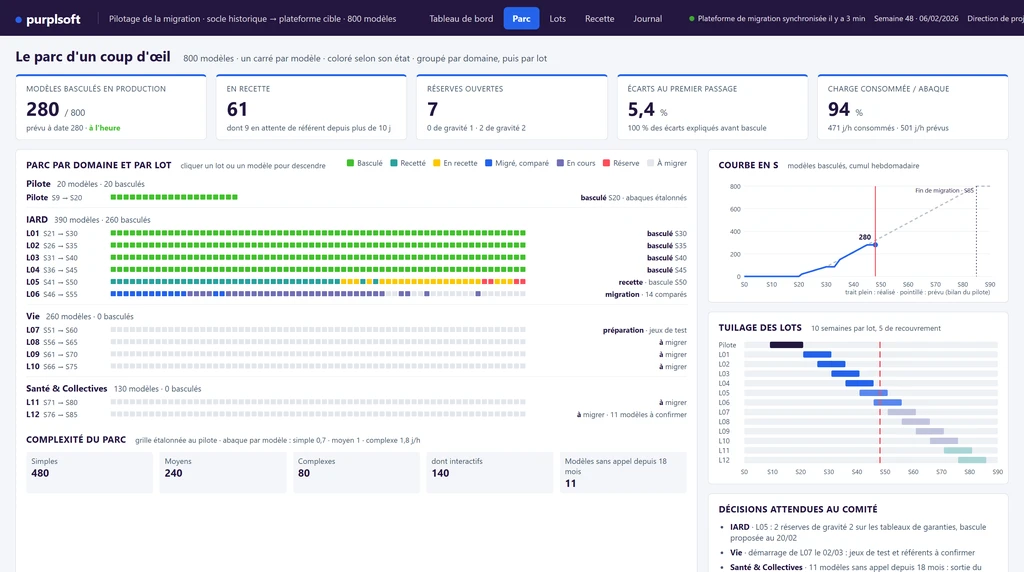
To steer the programme: a project steering console
Alongside Atlas, a dedicated steering console shares the schedule, workload, capacity indicators and progress with every stakeholder, and speeds up estimating and reporting.
04
// 04 · ecosystem
Expertise in legacy systems, openness to modern platforms
Openness & interoperability
From legacy systems to next-generation document platforms
We combine in-depth knowledge of legacy document environments with command of modern platforms and their integration mechanisms.
Our approach favours openness: an independent representation model, exchange formats, and the APIs and import mechanisms specific to each target engine, without imposing a single document engine.
Legacy expertise
Exchange formats
API
Interoperability
Target platforms
A network of specialised experts
Knowledge of the main legacy CCM environments: their formats, their composition rules and their operational specifics.
Command of target ecosystems
Making the most of the import formats, APIs and integration mechanisms offered by modern platform vendors.
Paths suited to each context
A technology-independent approach, to build migration scenarios suited to each organisation’s constraints and choices.
A migration is above all a programme to organise and control
We support organisations in defining and steering their transformation paths, bringing together technical teams, business experts, production managers and IT.
Scoping and qualifying the estate
Building the migration path
Organising batches and campaigns
Coordinating teams and contributors
Steering workload and capacity
Organising validation and acceptance
Tracking quality and progress indicators
Support through to decommissioning
06
// 06 · why now
What could not be costed now can be
For twenty years, shutting down a document platform was desirable in theory and unfundable in practice: nobody could say what it contained, what rebuilding it would cost, or how to prove the new chain would produce the same documents. Four obstacles have fallen together:
The estate has become measurable: automated analysis replaces manual archaeology.
Equivalence has become provable: document-by-document comparison replaces a hand-checked sample.
Rebuilding is no longer a wall: tool-assisted generation breaks the link with the number of templates.
The schedule is no longer tied to production: a November annual run can be validated in March.
Our founding article on decommissioning legacy CCM platforms: the four obstacles one by one, why migrating is above all about reopening a choice, and the first three steps before any major commitment.
07
// 07 · references
Programmes delivered over the long term
Public sector and large publishing organisations · Switzerland and Europe · 4 to 5 years
Decommissioning legacy platforms
Context
Legacy document platforms that had become hard to maintain: mainframe dependencies, bespoke unit processing, scarce skills.
Outcome
Legacy platforms fully decommissioned, no service interruption during migrations, and lower operating costs.
Insurance, social protection and pensions · France and Switzerland · 5 to 9 years
Converging multi-entity platforms
Context
Successive mergers, separate engines, thousands of redundant templates, several million documents a year in a regulated environment.
Outcome
Gradual unification on shared platforms, parallel-run migrations with no interruption, common document governance.
Document production and services · Switzerland · ongoing
Steering a multi-year programme
Context
Migration of several hundred document templates involving many stakeholders.
Outcome
A dedicated steering tool: schedule, workload and capacity indicators shared by every stakeholder, faster estimating and reporting.
Each engagement is described in full in our references.
Mass document production also raises the question of the accessibility of the documents it issues: this is where our document-production experience carries over directly, see our Accessibility practice.
Let’s talk about your document estate
Planning to modernise or migrate your CCM platform? Let’s discuss your challenges, your context and a suitable path.