The right order, not good intentions
Most CCM migration programmes that stall are not short of will or budget. They are short of order: migration starts before the estate has been measured, rationalisation happens during cutover, each entity is left to argue over its own catalogue with no mandate to settle anything. The result is not a visible failure but a silent drift: the programme moves forward, the schedule slips, and nobody quite knows why.
Governing a CCM migration means choosing the right order of decisions first. Rationalising the document catalogue is one of the hardest of them to untangle, because it touches several entities at once and has no natural owner.
Measure before deciding
No rationalisation can be governed on intuition. Before any trade-off, you need a real inventory of the estate: which templates are produced, at what volume over a rolling twelve months, which ones are variants of the same document, which ones no longer run. Without that measurement, a steering committee debates templates that disappeared long ago, and the real duplicates slip under the radar.
The measurement has to be shared before the first decision meeting, not produced as the debate goes on: a figure challenged in the room turns the whole meeting into a discussion of its reliability, rather than of the decision it was meant to inform.
Rationalising: the real governance decision
Rationalising a catalogue is not about deleting obvious duplicates. It means deciding, entity by entity, which template becomes the shared reference when two versions exist for historical reasons that no longer hold. The decision is political as much as technical: it touches service habits, and sometimes legal wording specific to one entity.
Who should lead the rationalisation of the template catalogue?
Rationalisation commits the document estate of several entities at once; it cannot be decided by the technical team alone. It must be led by a business and technical pair, with an explicit mandate to settle duplicates between entities, otherwise every trade-off is escalated and the schedule drifts.
Cut into reversible milestones, not large blocks
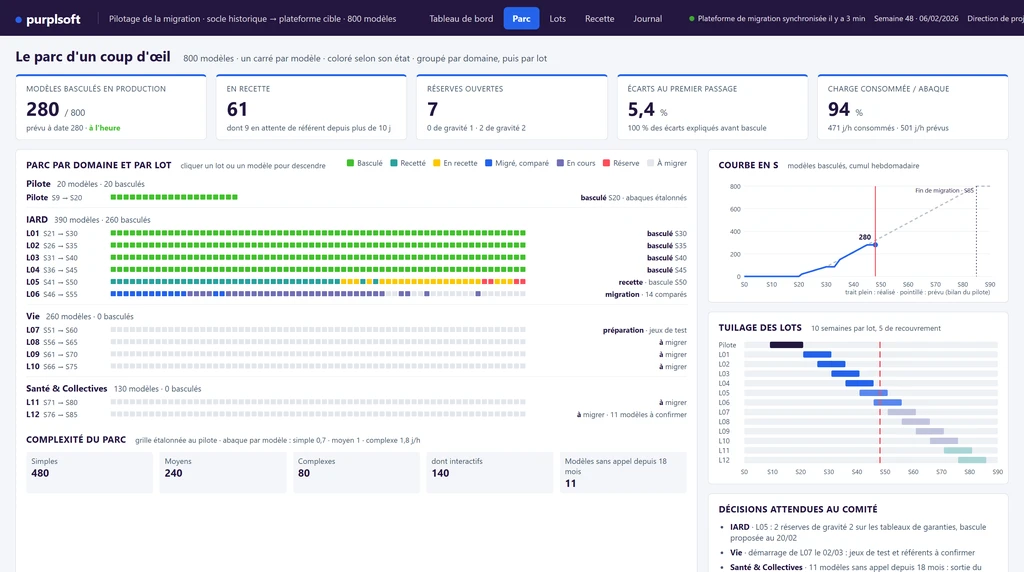
A migration programme that moves in large blocks exposes the whole estate at once: if a convergence rule turns out to be wrong, it has to be corrected everywhere before work can continue. The right grain is the reversible milestone: a lot of templates, rationalised, proven equivalent, cut over, before the next lot opens. An error then stays visible and correctable at the scale of one lot, not of the whole programme.
Parallel running follows the same logic: it is governed flow by flow, never platform-wide, so that cutting over one flow does not depend on the others.
Does production have to stop during rationalisation?
No, and that is precisely what makes it hard to govern: the production chain keeps running while the catalogue that feeds it is being rationalised. Cutover happens template by template, never platform-wide, so that a rationalisation error stays visible and reversible before it reaches production.
The most frequent governance pitfalls
Three drifts recur in most of the programmes we take over midway:
- Rationalising and migrating at the same time. A template that changes content AND platform in the same operation can no longer be compared to anything: document equivalence loses its point of reference. Rationalise first, migrate second, always in that order.
- Confusing “migrated” with “copied”. A template copied onto the target platform without document-by-document proof of equivalence has not been migrated; it has been duplicated as is, debt included.
- Keeping the old platform “just in case”. As long as it runs, licences, operations and scarce skills stay on the budget. The governance criterion is never “available”; it is “switched off”.
How do you measure the progress of a CCM migration programme?
Not as a percentage of templates migrated: a template that has been migrated but not proven equivalent to the source document does not count. Progress is measured in templates validated by automatic document-by-document comparison, and in flows actually cut over in parallel run, not in lines of configuration written.

What it changes for the steering committee
A steering committee that receives a measured estate, a clear rationalisation mandate and reversible milestones no longer decides in a rush. It decides on figures, entity by entity, and can turn down an exception without blocking the rest of the programme. That is what governance is really about: turning a hard political decision into a series of measured, reversible ones.